Governing AI means governing the responsibilities it generates.
AISMA has developed a Cognitive Governance model designed to integrate AI systems, operational rules, and information assets within a coherent and verifiable framework.
An approach that enables organizations to maintain visibility, accountability, and governance capability throughout the entire operational cycle.
We give structure to knowledge. We give control to decisions.
Every organization operates on the basis of principles, responsibilities, and criteria that consolidate over time.
The AISMA Method was developed to make this heritage explicit, structured, and available to AI systems, creating the conditions for technology, people, and activities to operate within the same organizational model.
The Three Pillars of Cognitive Governance
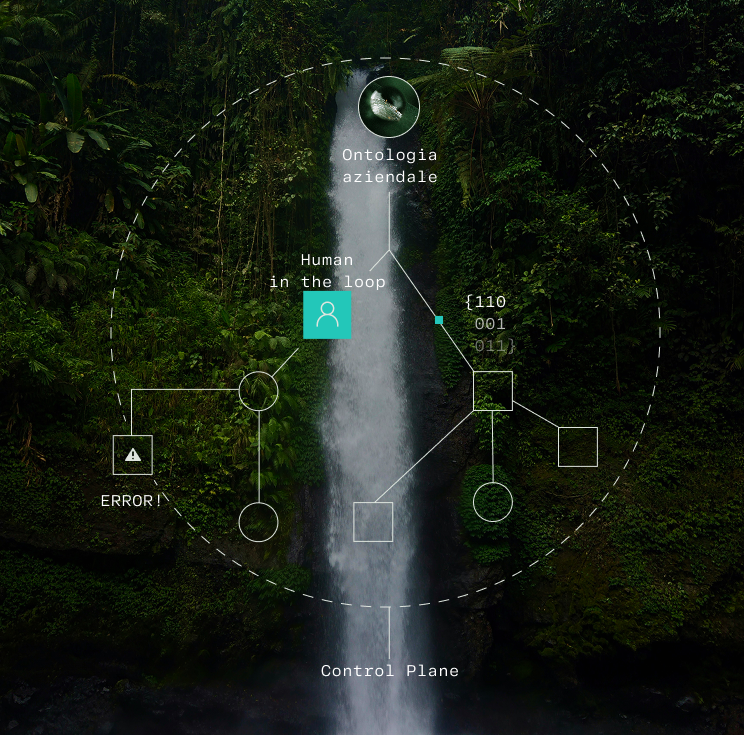
The effectiveness of artificial intelligence depends on the ability to integrate it within a coherent organizational model. This is why the AISMA Method is built on three complementary pillars that organize information assets, operational responsibilities, and intelligent technologies within a coherent model.
Together they make possible a use of artificial intelligence that is aligned with the organization’s rules, objectives, and ways of operating.
ONTOLOGY
Organizational knowledge becomes a structured asset.
Every organization builds over time a body of information, expertise, procedures, and operational criteria that guide its activities.
The organizational ontology makes this heritage explicit and shared, transforming it into a structured model that enables people and AI systems to operate within the same organizational context.
HUMAN IN THE LOOP
Human Responsibility.
Every organization manages activities with different levels of impact and risk. For this reason AISMA applies the Human in the Loop model, an approach that calibrates the autonomy of AI systems according to the operational context and the thresholds defined by the organization.
In the most critical contexts, the system engages the relevant human experts, transfers the assessment to human oversight, and maintains alignment with responsibilities, regulatory requirements, and operational practices.
CONTROL PLANE
AI operates within a shared model.
In organizations, artificial intelligence is often adopted through tools, applications, and initiatives developed at different times. Without a common governing layer, this evolution can generate fragmentation, operational inconsistencies, and growing management complexity.
This is why AISMA introduces Cogniss, the cognitive control plane that integrates AI applications, information, and organizational policies within the same operational framework.
Artificial Intelligence as an Organizational Capability
When these three pillars operate together, artificial intelligence ceases to be a technology separate from the organization and becomes an integral part of its functioning and structure.
Information, responsibilities, and AI systems converge within the same context, fostering strategic alignment, operational effectiveness, and the capacity to evolve over time.
Verifiable Outputs
People, activities, and systems operate on the basis of shared references, fostering alignment and operational continuity.
How Cogniss enables it
It centralizes the organization’s information assets and makes them available in a coherent manner to AI systems.
Accountability of Assessments
Every output can be traced back to the information, rules, and criteria that guided its processing.
How Cogniss enables it
It structures ontologies, policies, and operational logic within a shared and queryable model.
Operational Efficiency
Immediate access to information and expertise reduces redundant activities and accelerates process execution.
How Cogniss enables it
It organizes information assets, operational rules, and AI systems within the same working environment.

Risk Reduction
Responsibilities, autonomy levels, and organizational oversight remain explicit throughout high-impact activities.
How Cogniss enables it
It integrates risk thresholds, operational rules, and human involvement in contexts that require assessment and accountability.
Verifiable Outputs
People, activities, and systems operate on the basis of shared references, fostering alignment and operational continuity.
How Cogniss enables it
It centralizes the organization’s information assets and makes them available in a coherent manner to AI systems.
Accountability of Assessments
Every output can be traced back to the information, rules, and criteria that guided its processing.
How Cogniss enables it
It structures ontologies, policies, and operational logic within a shared and queryable model.
Operational Efficiency
Immediate access to information and expertise reduces redundant activities and accelerates process execution.
How Cogniss enables it
It organizes information assets, operational rules, and AI systems within the same working environment.
Risk Reduction
Responsibilities, autonomy levels, and organizational oversight remain explicit throughout high-impact activities.
How Cogniss enables it
It integrates risk thresholds, operational rules, and human involvement in contexts that require assessment and accountability.

Skills
Vertical capabilities designed to apply artificial intelligence across the primary enterprise domains.
Each Skill combines specialized expertise, operational context, and industry requirements within dedicated solutions for finance, legal, operations, and sustainability.